

AI implementation for professional firms and trade businesses. One workflow, from scope to handoff.
What you buy
One workflow fixed at a time: the place where client requests, handoffs or AI use stall. Every offer has its own page. See every offer.
How it starts
A free 30-minute call or the free Test Kit. Every engagement is scoped to your firm, and you get a written scope and price before anything starts.
If it does not work
Nothing is sold before the workflow is understood. Builds ship with review, an audit trail and rollback, so a change can be undone.
The person who scopes the work builds it.
Rodgers Intelligence Group is Mike Rodgers' Denver company. He scopes the workflow with your people, builds it, writes the acceptance checks you approve before the build starts, and stays until a named owner on your team can run it.
Strategy first. AI second. Automation third.
How the work runsEvery way onto the track.
Start free. Move up only when a finding says to. Everything is priced after a short conversation. See every offer
Free intake Test Kit
For:Small firms and professional-service practices.
Twelve checks across capture, delivery, ownership and recovery, run with synthetic data. Nothing is transmitted.
Open the offerIntake & Follow-up Build
For:Firms where a valid inquiry does not reliably reach a named owner.
One intake and follow-up workflow, scoped, built and handed to a named owner on your team.
Open the offerOne-Workflow Review
For:Teams whose handoff crosses systems and nobody owns the next action.
One workflow across up to three connected systems, investigated before you commit to a build.
Open the offerAI packages: the assessment ladder
For:Firms that tried AI tools and nothing stuck.
Six rungs from a free test to builds and ongoing care. Move up only when a finding says to.
Open the offerProfessional AI role setups
For:One professional, an executive or a team with a recurring job.
A working setup around a recurring job, with less tool switching.
Open the offerRIG Desk
For:Operations leaders who need a record of the AI work the firm runs.
A clear record of the AI work your firm runs for its own operations.
Open the offerPrivate AI
For:Firms that cannot send client information to public AI services.
A useful AI workflow inside your own infrastructure boundary.
Open the offerAgent governance
For:Teams putting AI agents into working processes.
Approval boundaries, completion evidence and a reviewable record for AI agents.
Open the offerCustom apps
For:Workflows that are missing a tool.
An internal application, a client-facing app, or a decision and routing tool.
Open the offerWebsites that look like they cost more than they did
For:Services that are hard to explain on the current site.
An award-grade site for your firm, built the way ours is. Portfolio coming: demo sites for a fitness studio, a consultancy and Denver local businesses.
Open the offerGitHub repo access
For:Owners and technical staff who want to see the work before they ask for it.
Open-source repos, free to read. Private repos by request, priced after a short conversation.
Open the offerBuilt for firm owners and operators, solo to 200 staff. Not for IT departments buying tools.
How the work runs: on the pit wall, then in the garage
Scope before promises.
- Diagnostic conversationWe look at one workflow end to end and name where it slips. No commitment to build anything.
- Agreed build boundaryA written scope: what is in, what is out, and which systems the work crosses.
- Acceptance checksWhat working means, written as checks and agreed before any build starts.
- Handoff planSource, configuration and operating notes go to a named owner on your team.
Strategy. AI. Automation.
- StrategyFind where the business makes and leaks money. Pick the one workflow worth fixing first.
- AIBuild the engine with guardrails, review gates and an audit trail from day one.
- AutomationPut it in production. Measure it. Keep it improving.
- HandoverThe source or configuration and the operating notes go to a named owner, with the acceptance evidence and a defined support path.
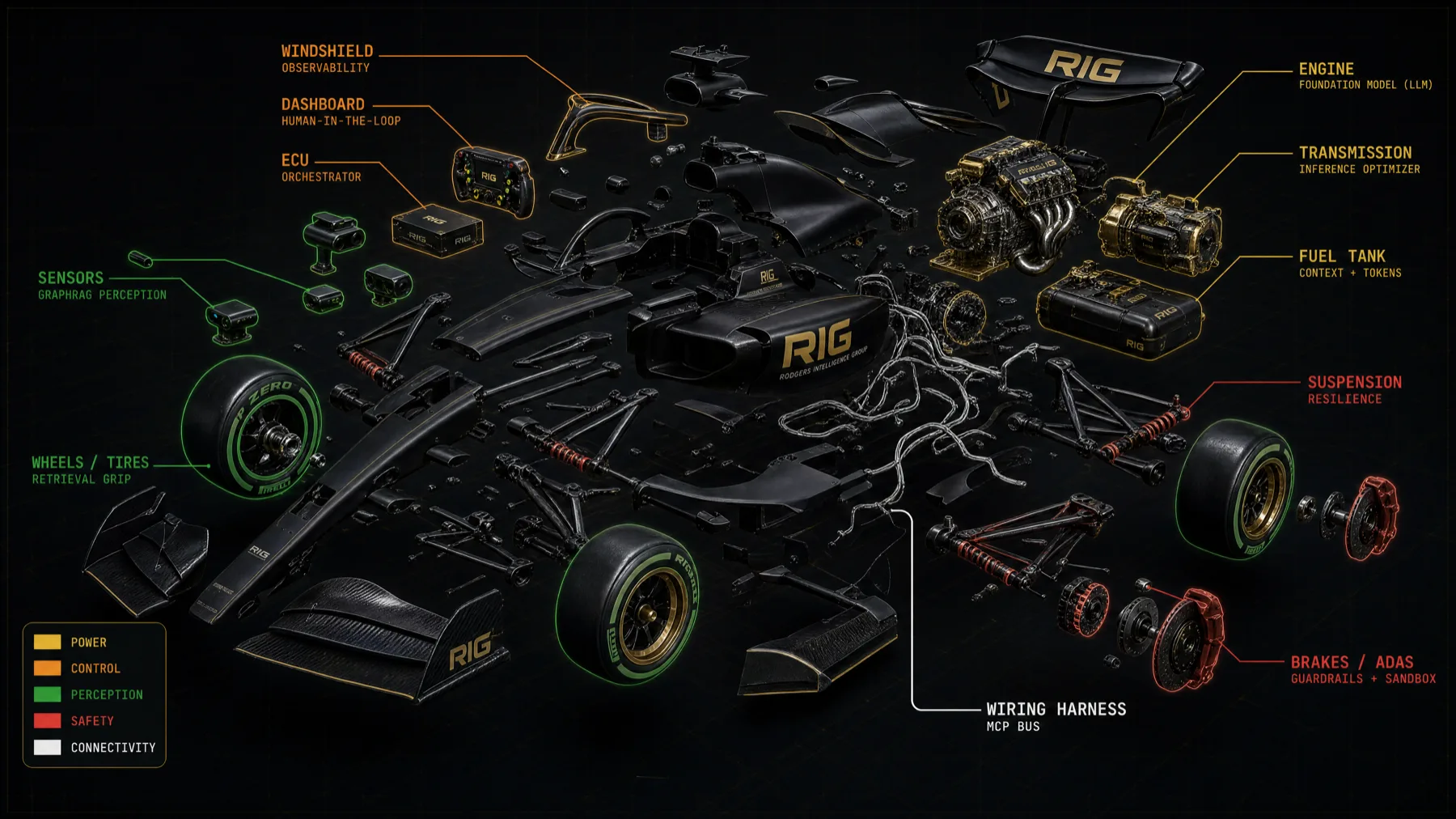
AI is a car.
The model is only the engine. Nine parts make the car run, and each one has a job in your business.
-
01
The tub: orchestration
What it does. One program runs the whole job: think, act, check, repeat, stop. It decides when the AI stops thinking and starts doing.
Without it. Nobody is driving. Requests stall mid-job or repeat forever, and no one can say where the work is.
See the part -
02
The engine: the model
What it does. It is the raw thinking power, and the part everyone over-buys. It makes horsepower, not decisions about your business.
Without it. Nothing reasons at all, so nothing gets drafted, read or answered. But buying a bigger engine does not steer the car.
Right-size the engine -
03
The gearbox: inference
What it does. It turns raw power into usable speed, so answers come back in seconds and the cost per job stays sane.
Without it. The car idles forever. Staff wait on answers, or the bill per answer climbs until nobody uses the tool.
Make it fast enough -
04
The fuel: context
What it does. It feeds the model the right facts: your documents, your numbers, your rules. Tokens cost money and heat, so five right pages beat the whole library.
Without it. The engine runs on air. Answers sound confident and cite nothing, or the wrong client's file shows up in the reply.
Check the fuel line -
05
The nose: retrieval
What it does. It reads your documents, databases and tools, and grounds every answer in what is actually on file.
Without it. The car hits the wall. A hallucinated clause or a stale rate sheet reaches a client before anyone catches it.
Ground the answers -
06
The wiring: tools
What it does. APIs and the Model Context Protocol connect the AI to the systems you already run, so it acts instead of only describing.
Without it. The engine never touches the road. Staff copy and paste between the AI window and the real system, and the savings never arrive.
Wire it up -
07
The brakes: guardrails
What it does. Approval gates, deterministic fallbacks and a sandbox. The brakes are what let you drive hard, not the paperwork after the crash.
Without it. One bad send reaches a client unsupervised, and the fix is deleting emails instead of trusting the tool again.
Set the boundaries -
08
The wheel: the human
What it does. A person issues the instruction, watches the logs and can take the wheel at any point. The screen shows what the agent did and why.
Without it. Nobody owns the output. When something goes wrong, no one can explain what happened or why.
Keep the record -
09
The halo: governance
What it does. Review, audit trail and rollback, fitted so the driver can be pushed harder, safely. This is what makes the whole car insurable.
Without it. The first mistake ends the program. There is no way to show what the system did, so there is no way to trust it again.
Fit the halo
The tub: orchestration
One program runs the whole job: think, act, check, repeat, stop. It decides when the AI stops thinking and starts doing.
See the partWhere do new client requests get lost?
That is the whole question. A prospect emails, calls or fills the form; the money is in what happens next. The free Test Kit runs twelve checks on one intake path and shows you exactly where it breaks.
- Capture. Does every way in, the form, the email, the phone line, land in one place someone owns?
- Delivery. Does the request actually reach a named owner the same day?
- Ownership. Can you say, today, who is holding each open request?
- Recovery. When something stalls, does anyone go get it back?
Is anything on this site a client result? No. Every worked example is labeled a demonstration, not a client result.
Delivery
The stored request never reached a named owner.
Ownership
The voicemail path was not exercised.
Sample, not a client result. Untested paths stay visible instead of assumed.
Start from the work you know.
The same problem shows up differently in each trade.
- Law firmsNew-matter inquiries going cold before anyone calls back.Open page
- Accounting and taxBusy-season onboarding and missing-document handoffs.Open page
- Home servicesMissed calls when the crew is busy.Open page
- Electrical contractorsWorkflows between the field and the office.Open page
- ConsultanciesProposal-to-kickoff and delivery handoffs.Open page

The person behind RIG.
I work at the intersection of business strategy and AI engineering.
I'm interested in the distance between a promising idea and something a team can actually use. That means understanding the business, making the tradeoffs explicit and staying close to the build.
Not a vendor. Not an advisor. An operator. Mike installs the judgment first, then automates it, so the system keeps working after he leaves the room.
40 Deviation Engines
Open source: 40 deterministic strategies, 20 cognitive, 10 nature, 10 physics. Read the repos
Milwaukee Tech Hub Coalition: Executive Board Member and Chairman, 2017 to 2020.
Book Mike to speak
Three talks, drawn from the work on this site. Priced after a short conversation.
- AI is a car: what the model is and is not.
- Scope before promises: why workflows fail without a boundary.
- Judgment first, then automation.